
The CyberTipline is the United States' national system for reporting the online sexual exploitation of children, run by the National Center for Missing & Exploited Children (NCMEC). Its annual figures are among the most quoted numbers in child protection. NCMEC's published data for 2025 runs to 31 December 2025.
The headline figures
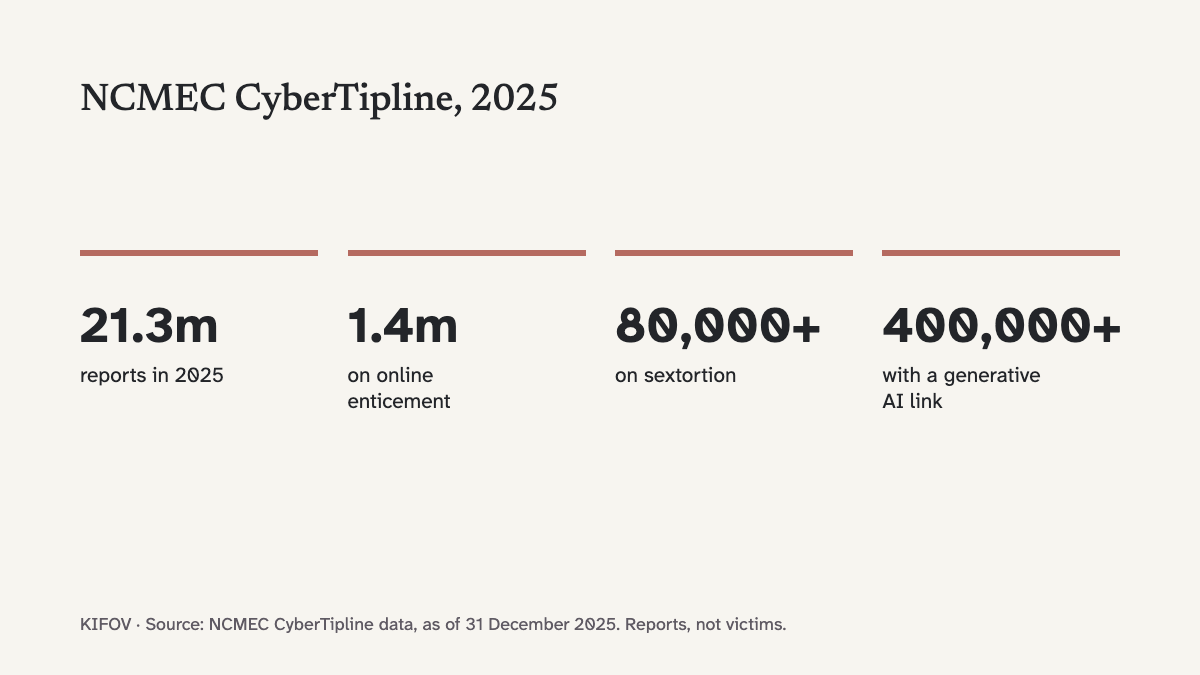
According to NCMEC, the CyberTipline received 21.3 million reports in 2025. Almost all of them, 21,181,300, came from electronic service providers: the companies that run social media, messaging, cloud and other online services. More than 170,000 came from members of the public.
Reports from companies contained 61.8 million images, videos and other files: 29.4 million images, 26.3 million videos and 6.1 million other files.
| Category (2025) | What NCMEC reports | Change |
|---|---|---|
| Online enticement | 1.4 million reports | up 158% on 2024 |
| Sextortion | more than 80,000 reports | not given |
| Financial sextortion | 137 reports a day on average | up 37% a day on 2024 |
| Child sex trafficking | total not given | up 323% on 2024 |
| Generative AI | more than 400,000 reports with a generative AI link | not given |
| Reports from victims themselves | more than 5,700 | more than double 2024 |
Of the reports with a generative AI link, NCMEC says more than 182,000 involved offenders possessing, generating or attempting to generate AI-generated child sexual abuse material.
How to read these numbers
A report is not a child. One report can concern many files, and many reports can concern the same child or the same image. NCMEC's figures count what it received, not how many children were harmed.
Company reports reflect company effort. More than 99% of reports came from service providers, so changes in how platforms detect and report material move the totals. A rise can mean more abuse, better detection, or both; a fall can mean less abuse, weaker detection, or encryption that hides material from the provider.
Some rises are clearer signals than others. Online enticement, which covers adults communicating with children in order to abuse them, and financial sextortion, where the offender demands money, are reported in categories that depend less on automated image detection. Steep increases there are harder to explain away as a counting effect.
The victim reports matter. More than 5,700 reports came directly from the young people affected, more than twice as many as in 2024. Each of those is a child who found the reporting route and used it.
What this means for families
NCMEC describes offenders who build a friendship or romantic relationship with a child first, often using false identities, before asking for images or money. That is why the early warning signs are a new online friend who quickly becomes important, and requests to move the conversation somewhere more private. Our guides set out what to do in the first hour if a child is being blackmailed, and how to report images found online.