
Most people who come across sexual images of a child online do not go looking for them. They find them in a group chat, behind a misleading link, in the comments under a video, or in a folder someone sends them. The instinct is to do something immediately: screenshot it as proof, forward it to someone who can help, or email it to an organisation. Each of those is a mistake, and some of them are crimes.
This guide sets out the safe route, which is the same in almost every country: report where the material is, not the material itself, to a hotline that is trained and authorised to deal with it.
Why you should never save, screenshot or forward it
Child sexual abuse material is a record of a crime against a real child. Every copy and every share adds to the harm done to them. In most countries, possessing or distributing it is a criminal offence whatever the intention, and "I was trying to report it" is not a defence you want to rely on.
There is also a practical reason. Hotlines do not need the file. They need to know where it is. Analysts at a hotline can view the page safely and lawfully, assess it, trace where it is hosted and work with the hosting company and with police. A screenshot in your phone helps none of that.
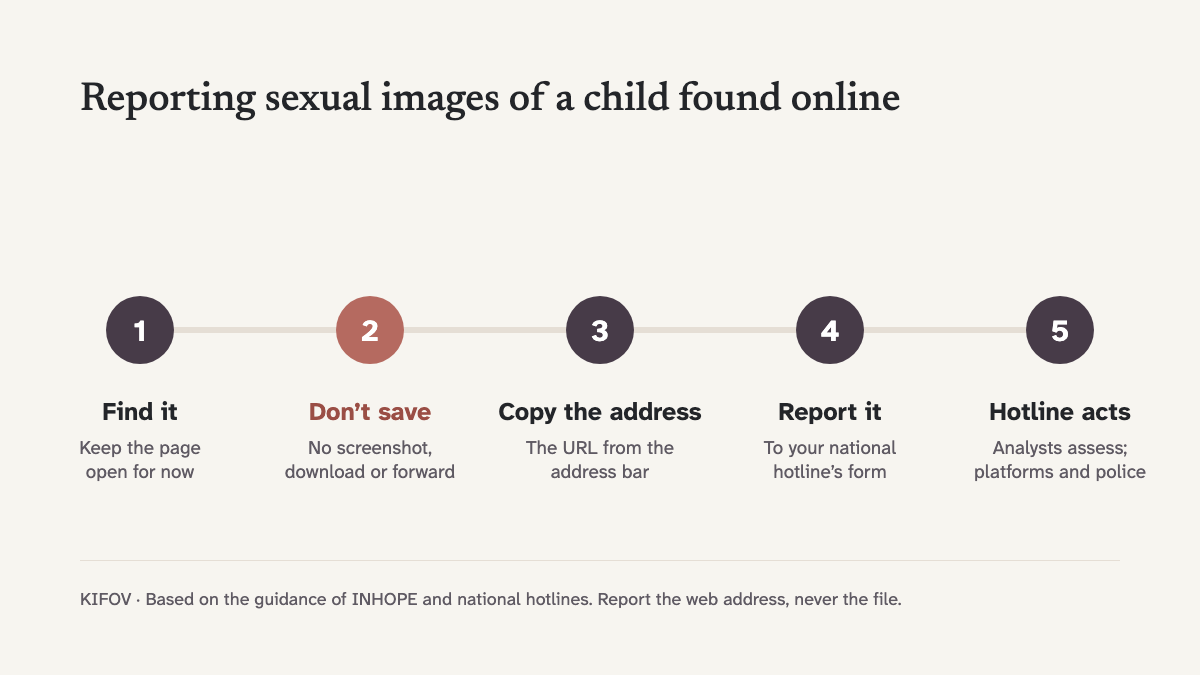
INHOPE, the international network of hotlines, puts it plainly: keep the page open long enough to copy its address, do not share the content with anyone, and never send it by email.
The route, step by step
- Stay calm and keep the page open. You only need it long enough to copy the address.
- Do not save, screenshot, download or forward anything.
- Copy the web address (URL) from your browser's address bar. In an app, use "Copy link" or "Share" and copy the link, without opening it again.
- Report the address to your national hotline, using its online form. You usually do not need to give your name. If what you saw was in an app or game, also use the app's own report button.
- Close the page, and look after yourself. Seeing this material is distressing. It is normal to need to talk about it; see Get Help for support services.
If you know or suspect that a particular child is being abused now, or is in danger, that is an emergency: call the police on your local emergency number before anything else.
Where to report
| Country | Service | What it receives |
|---|---|---|
| United States | NCMEC CyberTipline | Reports of online child sexual exploitation, including abuse material, enticement and sexual extortion. Online, or by phone on 1-800-843-5678. |
| United Kingdom | Internet Watch Foundation | Sexual images and videos of children online, including AI-generated, drawn and animated images. Anonymous if you wish. |
| Canada | Cybertip.ca | Canada's national tipline for online sexual exploitation of children, run by the Canadian Centre for Child Protection. |
| Australia | eSafety Commissioner and ACCCE | eSafety can have illegal content, including child sexual abuse material, removed; the ACCCE receives reports of online child sexual exploitation. |
| Anywhere else | INHOPE hotline finder | Links to the national hotline in each member country. |
The details above were checked on each service's own website on 30 October 2026. Our Report a Concern page always shows the latest checked version.
If there is no hotline in your country
Not every country has a hotline. If INHOPE does not list one for yours, report to the police. Do not send them the material either: describe where you saw it and give the web address. Some hotlines in other countries accept reports from abroad; their websites say whether they do.
Mistakes people make with the best intentions
- Sending it to a charity or journalist "so someone sees it". Organisations without hotline authorisation cannot lawfully receive it, and you may have committed an offence by sending it. KIFOV does not accept such material.
- Posting about it publicly to warn others. Sharing the link, even with a warning, spreads it.
- Confronting the person who shared it. This can alert them to delete evidence or move material elsewhere, and can put you at risk.
- Assuming someone else has reported it. Hotlines would much rather receive the same address twice than not at all. INHOPE says you do not need to be certain that something is illegal before reporting it.