Get Help Report a Concern
Research

What we found checking 32 child help services in six countries

Every country we covered has a free child helpline and an emergency number. Fewer offer text, a route for young people to remove their own images, or say which languages they support.

  • Fact-checked
  • 5 primary sources
  • AU · CA · GB · IE · NZ · US
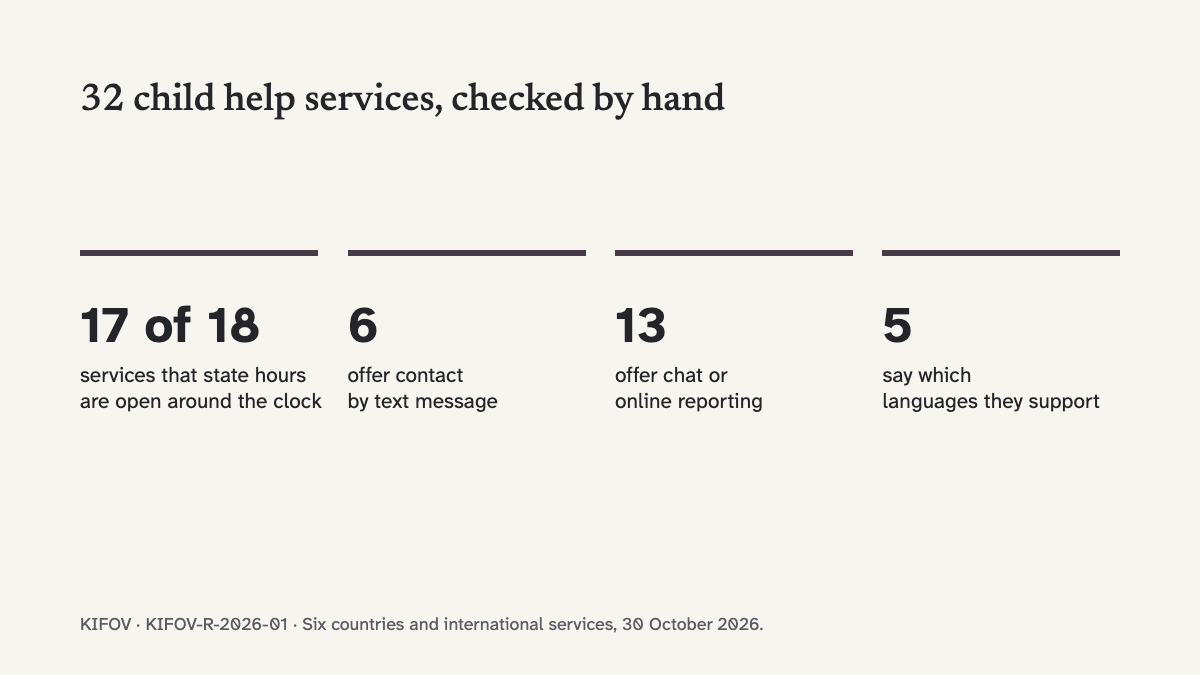
Four figures from KIFOV's check of 32 help services: 17 of 18 services that state their hours are available around the clock; 6 offer contact by text; 13 offer chat or online reporting; 5 state the languages they support.
Findings from KIFOV's check of its help directory, 30 October 2026. KIFOV illustration.
In this article
  1. Key findings
  2. The services, by type
  3. What we recommend
  4. How to cite
  5. Sources

To build KIFOV's help directory, we opened the official website of every service we list and recorded what each one says about itself: who it is for, how to contact it, when it is available and what it can do. This report summarises what that check found across 32 services: 28 national services in Australia, Canada, Ireland, New Zealand, the United Kingdom and the United States, and 4 international ones.

Key findings

  1. Every country we covered has both a published emergency number and a dedicated helpline for children and young people. In all six, we confirmed the emergency number on an official source.
  2. Around-the-clock help is the norm where hours are stated. Of the 18 services that publish their hours, 17 say they are available 24 hours a day. The exception is the UK's NSPCC adult helpline, which publishes weekday office hours for phone calls.
  3. Text is still the exception. Only 6 of the 32 services offer contact by text message. For many teenagers, texting is easier than calling; where text exists, it is worth saying so prominently.
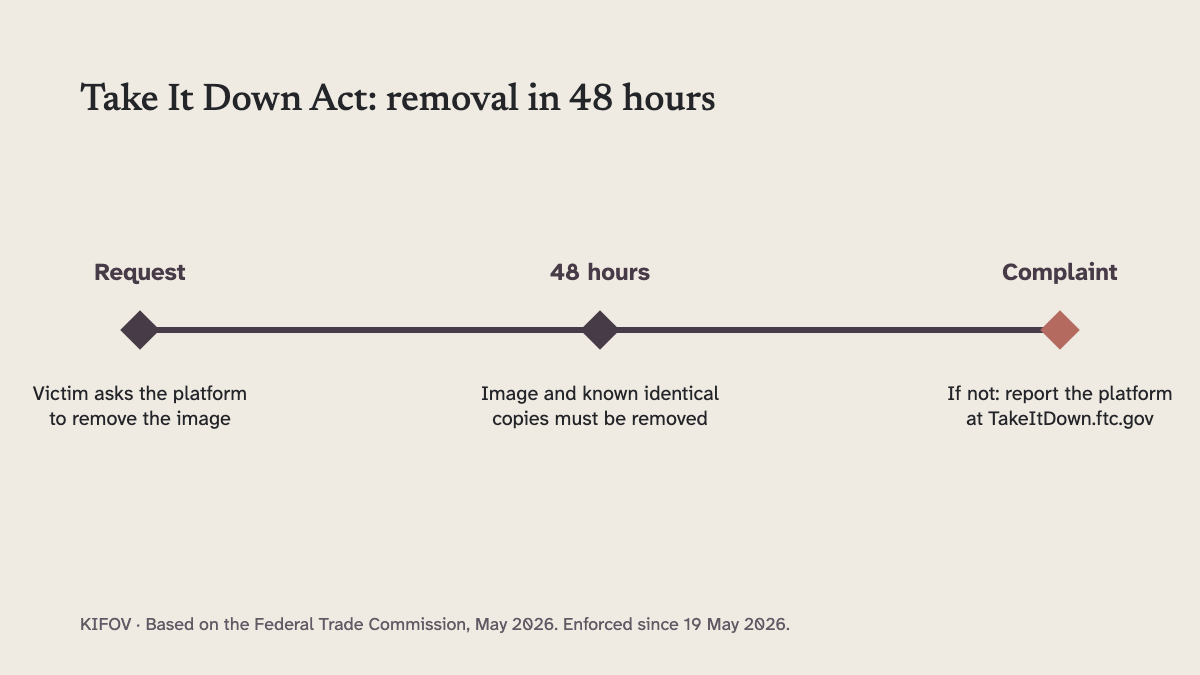
  4. Routes for young people to remove their own images exist, but not everywhere. Dedicated removal services for under-18s were found for the UK (Report Remove), Canada (NeedHelpNow.ca) and internationally (Take It Down, run from the US). In the other countries we covered, young people are directed to general reporting routes or regulators.
  5. Languages are rarely stated. Only 5 services say which languages they support. For families who do not speak English at home, that matters.

The services, by type

Type of service Number in the directory
Emergency services 6
Child helplines 6
Crisis lines 5
Hotlines for child sexual abuse material 5
Image removal for young people 3
Online safety regulators 2
Reporting online exploitation 2
International directories 2
Support for parents and carers 1

What we recommend

  • Services: state opening hours, text and chat options and supported languages on the first page a visitor sees.
  • Platforms: link to the national child helpline and the relevant hotline in the reporting flow, not only in a help centre.
  • Governments and regulators: where there is no dedicated route for young people to remove their own images, consider one; the UK and Canadian models are well documented.

How to cite

KIFOV (2026). What we found checking 32 child help services in six countries. KIFOV-R-2026-01, version 1.0. https://kifov.org/research/what-we-found-checking-32-child-help-services/
What is known

  • All 32 services were checked on their official websites on 30 October 2026.
  • 17 of the 18 services that publish hours say they are available around the clock; 6 offer text; 13 offer online chat or online reporting.

Still open

  • Whether services offer options they do not mention on their websites; we recorded only what each service states publicly.
  • How quickly services respond in practice; we did not test response times.

How we made this

A member of the KIFOV team opened the official website of each service between 29 and 30 October 2026 and recorded, from that site only, the service's purpose, contact methods, published hours, languages and audience. Where a site blocked automated access, it was opened in a standard browser. A feature counts only if the service's own site states it. Counts were taken from the directory database on 30 October 2026.

Limitations

Six countries, all English-speaking, chosen because their services publish stable information we could check directly. A service missing from our directory is not evidence that no such service exists in that country. The findings describe what services say about themselves, not their quality.

About this piece

Type
Research
Evidence
Primary evidence
Sources
5, 5 primary
Countries
Australia, Canada, United Kingdom, Ireland, New Zealand, United States

Sources

  1. Child Helpline International: helplines Child Helpline Internationalaccessed 30 Oct 2026
  2. INHOPE: How to report INHOPEaccessed 30 Oct 2026
  3. Take It Down National Center for Missing & Exploited Childrenaccessed 30 Oct 2026
  4. Report Remove Childline (NSPCC) and Internet Watch Foundationaccessed 30 Oct 2026
  5. NeedHelpNow.ca Canadian Centre for Child Protectionaccessed 30 Oct 2026

Updates and corrections

None since publication. Spotted an error, or named in this piece? Contact the editors; we record every substantive change here (corrections policy).