
For years, arguments about children's safety on social media have ended in the same place: a hearing, a promise from the company, a new setting. In New Mexico, the argument went to trial, and the result is a document that tells a platform what it must do.
What happened
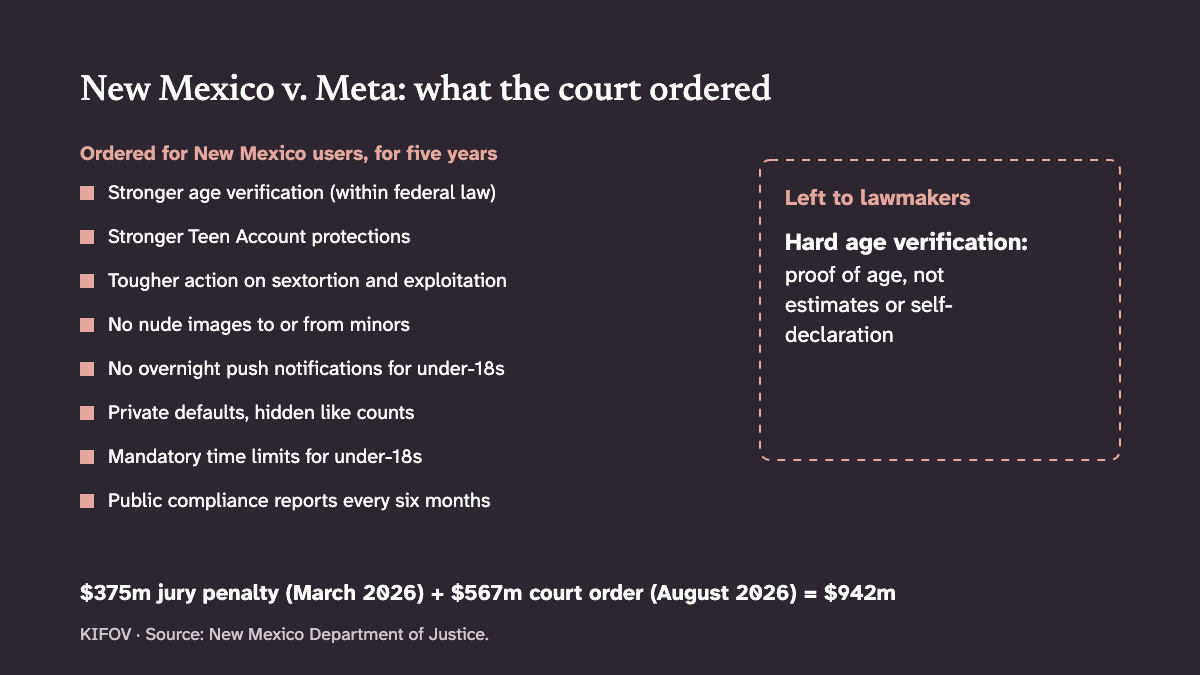
The case began with an investigation by the New Mexico Department of Justice in 2023. In March 2026, a jury found Meta liable under the state's Unfair Practices Act for misleading consumers about the safety of its platforms, and imposed the maximum penalty of $5,000 per violation: $375 million in total, for 75,000 violations.
On 7 August 2026, the First Judicial District Court entered its final judgment in the second phase of the case. Judge Bryan Biedscheid ruled that Meta's platforms constitute a public nuisance in New Mexico, rejected the company's argument that Section 230 of the Communications Decency Act shielded it from liability for how it designed its products, and ordered Meta to pay a further $567 million. According to the state, that brings the total to $942 million, and it is the first time a court has held a social media company financially and structurally accountable for building products that endanger children.
What the court ordered
The money attracts the headlines. The more consequential part is the list of changes, which apply to New Mexico users, last for five years, and are supervised by the court. As described by the state, Meta must:
| Area | Change |
|---|---|
| Age | Use more rigorous age verification for New Mexico users, within the limits of federal law |
| Teen Accounts | Maintain and strengthen existing protections |
| Exploitation | Strengthen safeguards against sextortion and child sexual exploitation, and enforce more strictly against offending adult accounts |
| Images | Prevent minors from sending or receiving nude images that breach Meta's policies |
| Night-time | Stop push notifications to under-18s overnight |
| Privacy | Apply private defaults for minors, including hiding public like counts |
| Time | Impose mandatory time-use limits for under-18s |
| Warnings | Display prominent disclosures about the risks of its platforms |
| Education | Fund a statewide public awareness campaign |
| Police | Provide training and resources for investigators of internet crimes against children |
| Reporting | File public compliance reports with the court every six months |
What it left out
The court did not order the measure the trial record pointed to most strongly: hard age verification, meaning proof of age rather than estimates and self-declaration. The state's own account is that this was deliberate restraint. The judge held that a policy choice of that size belongs to legislators, not courts. The Attorney General has said he will take an age-verification bill to the state legislature.
That gap matters. Almost every other item on the list depends on the platform knowing who is a child. Overnight notification limits, time caps and private defaults protect a teenager only if the account is recognised as a teenager's.
What it means outside New Mexico
It is a working template. Child protection organisations have long published lists of design changes they want platforms to make. This judgment turns a version of that list into enforceable obligations with deadlines and public reporting. Other states, and regulators abroad, now have a precedent to point to.
The six-monthly reports will be the real test. A court order is only as good as the evidence that it is being followed. Public compliance reports should show, for the first time, how a large platform measures things like overnight notifications to minors or the enforcement of rules against adults who contact children. We will read them when they appear.
It does not apply to children anywhere else. The changes are ordered for New Mexico users. Meta may choose to apply some of them more widely, but the judgment does not require it.
What parents can do now
Nothing in the judgment changes what a parent can do today, wherever they live. On Instagram and Facebook, check that a teenager's account is set up as a teen account, review who can message them, and turn on the time and notification limits the apps already offer. If a child is being pressured for images or blackmailed, see our first-hour guide.