
AI companion apps let people chat, often for hours, with characters that remember them, respond warmly and are always available. For teenagers, that can be entertaining and comforting. It can also be isolating, and it raises questions that families, schools and regulators have only begun to ask.
In late 2025, Character.AI, one of the best-known of these apps, made a significant change: it stopped allowing users under 18 to have open-ended chats with its AI characters.
What the company changed
According to Character.AI's own announcements:
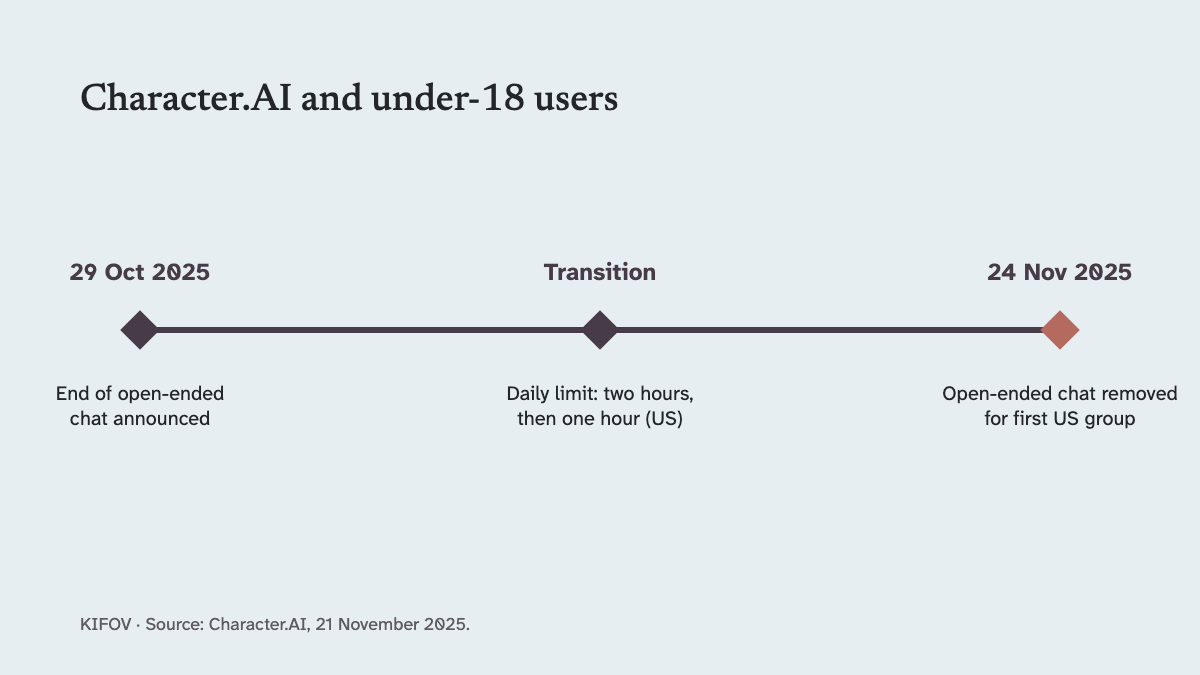
- On 29 October 2025, it announced that open-ended chat would end for under-18 users.
- During the transition, teenagers' chat time was limited, first to two hours a day, then reduced to one hour a day for users in the United States.
- From 24 November 2025, the first group of under-18 users in the US began losing open-ended chat, with other countries to follow. A second group kept the one-hour limit for some weeks, with at least two weeks' notice of their change.
- Teenagers can still use other features: an interactive feed, image creation (Imagine), Avatar FX and Streams.
- The company said it had begun rolling out new age assurance technology in the US, with a global rollout planned.
The company said the decision followed input from safety partners and outside experts.
What the change tells us
The feature itself was withdrawn for under-18s. Most safety changes for teenagers add controls to the existing product. Removing open-ended chat for under-18s is a different kind of decision: it treats the feature itself as unsuitable for that age group.
It depends on knowing who is a teenager. As with every age-based protection, it works only if the app can tell a 15-year-old from a 25-year-old. Age estimates can be wrong, and teenagers can try to get around them.
AI is now part of the exploitation picture. Separately from companion apps, NCMEC reports that the CyberTipline received more than 400,000 reports in 2025 with a link to generative AI. That figure covers many kinds of misuse, not companion chat in particular, but it is a reminder that children's safety with AI is no longer a future question.
Questions parents can ask
You do not need to know how a chatbot works to ask useful questions:
- Which AI apps or characters do you talk to, and what about? Ask with curiosity, not alarm.
- Does the app know your age? If it treats your child as an adult, its teen protections will not apply.
- How much time does it take up? Long daily sessions, or using it instead of friends, are worth talking about.
- Has it ever said something that made you uncomfortable, or asked you to keep something secret?
- What does it do if you mention feeling low? A responsible service should point to real help; if your child is struggling, make sure they also have people to talk to. See Get Help.